
A Caged Lion
why does she sing?

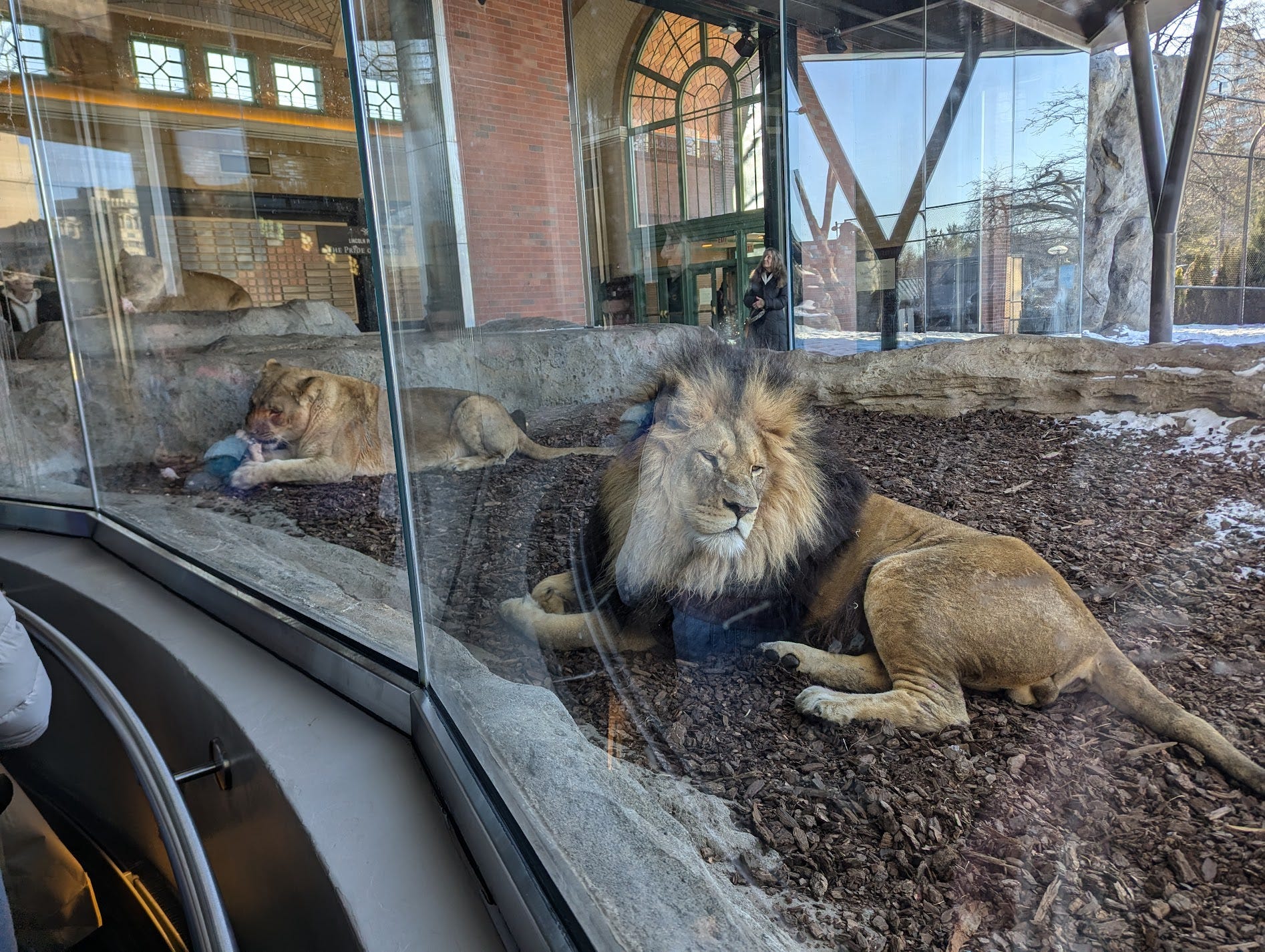
We like going to the zoo. Twenty minutes or so by bike down Clark Street and you’re there, the shining copper-green bears waving you in, free of charge.
Just steps inside the gate you’ll see the seals swimming round and round the edges of their pool; sometimes they’ll blow bubbles at you, or show off with their whiskers. Then the lion exhibit: it won a Chicago innovation reward, with zip lines that dangle the food — keep them exercised — and a huge viewing area so you almost always see them: often sleeping, right up against its tempered glass just inches from your face. You can see their breathing, the latent power in their claws.
But there’s a part of going to the zoo that I don’t like. You can see the paths the animals wear in the dirt. How they’ve time and again pushed right up to the glass —trapped. A “bird that stalks/ down his narrow cage,” writes poet Maya Angelou, “can seldom see through/ his bars of rage.”
I remember watching a monkey, sitting in the corner, tapping at his wall. Tap, tap, as if, with enough effort, it might someday give.
But mostly I remember the circling. The seals. The lions. The monkeys too. Around and around and around their cages, fur left on walls like a long ball and chain.
***
The earth circles the sun with exacting precision, retracing its path with a sidereal period of 365.256363 days, year after year after billions of years. Remarkably stable, the orbit is nearly (but not exactly) circular, counterclockwise as viewed from the northern hemisphere, with a slow apsidal precession (the shifting of its point of closest approach to the sun) of 112,000 years. Subject to the iron laws of Newton and Kepler, this object in motion will remain in this motion as long as our astronomical eyes can see.
Does our planet ever long for another star? To be rid of its gravitational chains? Shake free the centripetal force that binds its fate? Careful measurements of tiny perturbations in Earth’s orbit suggest it to be just slightly chaotic — not perfectly predictable over billions of years. Do we detect it shaking? A slight itching, perhaps, for change?
***
If you ask me how I’m doing right now, I’d probably say some nice happy things: good, Katelyn’s seven months pregnant, expecting, and I’m putting together an event I’m excited about Saturday (Banjo Astro After Dark - if you’re in Chicago do come by!). But if you pushed a little, how I’m really doing, I’d probably have to say: Stuck. Circling.
Some of it might be that feeling of helplessness, powerlessness in a world spiraling out of control. And some of it might be that so much I’m trying right now doesn’t feel like it’s going anywhere, like I keep pushing against these glass walls that won’t move. Some of it might be the lost feeling of directionless-ness.
But some of it, I don’t know. Do I know what keeps us confined and pacing? Why it is that no matter how much we eat we’re still hungry, that no matter how far we walk, we never fully arrive? “You can get there from here,” writes poet Natasha Trethewey, “though/ there’s no going home.”
Here’s what I do know: there are a lot of cages.
***
Trethewey has another poem, “Expectant,” about a girl, pregnant, trapped alone in her empty, solitary home. She winds the clocks, listens for his car on the road. I feel her love, as she sweeps the floor, but also her chains. She longs for the rest of a supportive home, or for the joy of the French Quarter — “lights, riverboats churning / the tinkle of ice in a slim bar glass.”
And yet, “she can fill a room / with a loud clear alto, broom-dance / right out the back door, her heavy steps / a parade beneath the stars.”
Of the caged bird Angelou writes: “His wings are clipped and / his feet are tied/ so he opens his throat to sing.”
***
Here’s another poem I can’t stop thinking about:
The tiger
He destroyed his cage
Yes
YES
The tiger is out
I couldn’t, unfortunately, tell you much about the poem, other than I saw it posted on Substack the other day, the poet’s name is Nael, and that it comes from a collection of student work.
And it probably was some sort of viral internet thing, which perhaps is a strike against it, but I don’t really care. I felt an overwhelming compulsion to tell people about it. To memorize it. To keep saying back to myself: yes. YES. The tiger is out.
***
The other day we received a card featuring a pretty print of a common wren, peaking through a faintly drawn rectangular window of fall colors, twigs, and fungi. It’s a little fluffy brown bird, one that I might not look twice when I pass it by.
On the inside, our friend had written: “Common Wren: Gracie, who painted it, told me it’s one of the few birds that sings all winter long…”
***
The last time I visited the zoo, the lions had been sleeping, so we’d moved on to other exhibits. I think we’d made it nearly to the penguins, or perhaps were about to enter the reptile house, when we heard the lion roar. A great echoing sound, such that people all around me stopped — mid ice cream lick — heads turning. Roar. ROAR.
At that rumble, something deep inside me broke open, cell door swinging. Katelyn and I looked at each other and then started running — running! — back toward the lions, back toward the creature, and his primal call.
***
The caged bird sings… of things unknown / but longed for still,” writes Angelou. “his tune is heard / on the distant hill.”
I really like this Luke, thank you!
Fantastic! Love this post!